
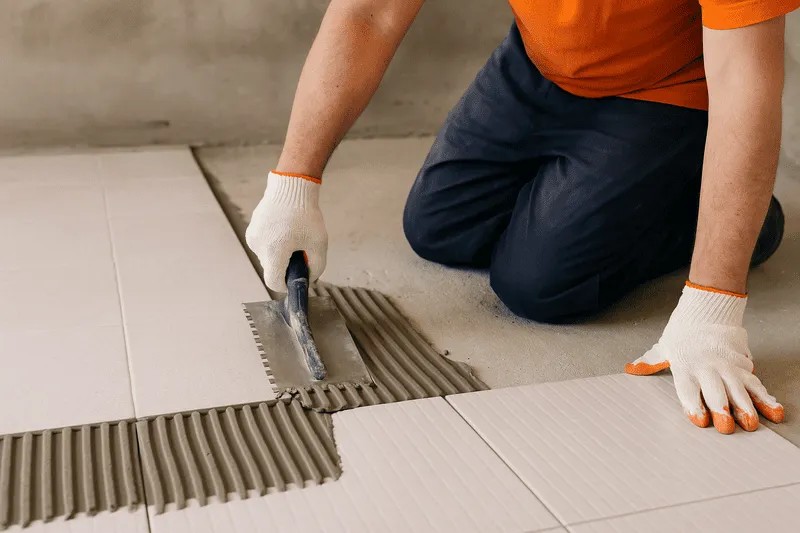

Tile quality and installer skill are not the only factors that affect wall tiling success. How quickly work is completed and how long-lasting the final surface depends heavily on the adhesive used behind the tile. On-site problems like uneven bonding, hurried fixing, and tile slippage are frequently attributed to adhesive formulation rather than craftsmanship.
For this reason, professional installers are increasingly considering performance features rather than just price when evaluating products. A reputable tile adhesive manufacturer develops products especially to regulate workability, open time, and slip resistance. Long-term tile stability, finish quality, and installation speed are all directly impacted by the choice of wall tile adhesive.
1. Tile Movement on Vertical Surfaces Is Prevented by Slip Resistance
One of the most frequent issues with wall installations is tile slippage. Uneven grout joints and misalignment result from tiles sliding downward under their own weight when the adhesive’s thixotropic qualities are insufficient.
Anti-slip additives are incorporated into premium wall tile adhesive formulations to keep tiles securely in place as soon as they are fixed. A professional tile adhesive manufacturer creates these formulations to support large formats and heavy tiles, enabling installers to work confidently without the need for spacers or frequent adjustments.
2. Installation Flexibility Is Determined by Open Time
The term “open time” describes the amount of time that adhesive is still workable on the wall following application. An excessively short open time causes the adhesive to skin over quickly, resulting in poor bonding and tile failures. Tiles may lose their initial grip if they are too long without the right formulation.
A well-balanced wall tile adhesive provides strong adhesion and enough open time for accurate placement. Reputable tile adhesive producers meticulously manage this balance to allow installers to work quickly and effectively without rushing or reapplying material.
3. Workability Impacts Finish Quality and Speed
The ease with which adhesive spreads, combs, and retains ridges is determined by its workability. Inadequate workability slows installation, increases fatigue, and results in uneven coverage.
Optimized fillers and polymers are used in advanced wall tile adhesive formulations to increase spreadability and smoothness. This lessens voids and strengthens the bond by enabling installers to complete tile coverage with uniform trowel lines. Faster installation times and cleaner finishes are directly correlated with good workability.
4. Performance Consistency Is Affected by Polymer Content
Modern tile adhesives heavily rely on polymers. They improve resistance to movement, adhesion, and flexibility—all of which are crucial for wall applications where gravity constantly adds stress.
To guarantee consistent performance under various site conditions, a reputable tile adhesive manufacturer meticulously calibrates the polymer content. This guarantees that wall tile adhesive keeps its bonding strength even when the site’s temperature, humidity, or substrate conditions change.
5. Managed Setting Time Enhances Productivity On-Site
Setting time has an impact on when tiles can be grouted and how fast the installation moves on to the next phase. While slow-setting products cause delays in project timelines, adhesives that set too quickly restrict adjustment time.
Reliable setting behaviour and adequate working time are balanced in well-formulated wall tile adhesive products. Because of this predictability, contractors can precisely plan workflows and prevent delays brought on by long wait times or premature curing.
Installation Success Is Driven by Adhesive Formulation
Adhesive chemistry has a significant impact on wall tiling performance. Workability, open time, and slip resistance are engineered properties that dictate how precisely and efficiently tiles can be installed; they are not incidental features.
Contractors can lower installation errors, enhance finish quality, and guarantee long-term durability by selecting products from reputable tile adhesive manufacturers and the appropriate wall tile adhesive for site conditions. The correct formulation is what separates confident execution from constant correction in professional tiling.