

Key Takeaways
- Mosaic tiles work best in modern interiors when treated as controlled accents, not dominant surfaces.
- Scale, colour restraint, and finish matter more than pattern complexity.
- Successful tile shopping in the city-state requires viewing mosaic tiles in context, not in isolation.
- Modern interiors favour intentional contrast, not visual noise.
Introduction
Mosaic tiles are often associated with decorative or traditional interiors, yet they continue to appear in contemporary homes across Singapore. The challenge is not whether mosaic tiles belong in modern interiors, but how they are used. Poor execution leads to visual clutter, while disciplined application enhances texture, depth, and spatial definition. That said, for homeowners navigating tile shopping today, especially when considering mosaic tiles in Singapore, knowing how to integrate them without clashing with modern design principles is critical.
Learn the Language of Modern Interior Styles
Modern interiors prioritise clarity. Clean lines, restrained palettes, and purposeful material selection define the space. Mosaic tiles, by nature, introduce complexity through repetition and surface detail. The key is alignment. Mosaic tiles should support the overall architectural intent, not compete with it. They function best as a secondary material that adds texture rather than as a primary visual feature.
That said, when tile shopping, assess whether the mosaic complements the dominant materials already present—such as large-format tiles, concrete finishes, timber laminates, or matte surfaces. Once the mosaic introduces a new colour family or finish that does not already exist in the space, it will likely feel disconnected.
Limit Mosaic Tiles to Clearly Defined Zones
One of the most common mistakes is overuse. Mosaic tiles, in modern interiors, should be confined to specific, functional zones. Typical examples include kitchen backsplashes, shower niches, feature strips in bathrooms, or bar counters. These areas benefit from visual emphasis without overwhelming the space.
Using mosaic tiles across full walls or multiple rooms tends to dilute modern minimalism. It is advisable to map out where mosaics will stop, not just where they will be installed. Clear boundaries preserve visual order.
Choose Subtle Colours and Low-Contrast Palettes
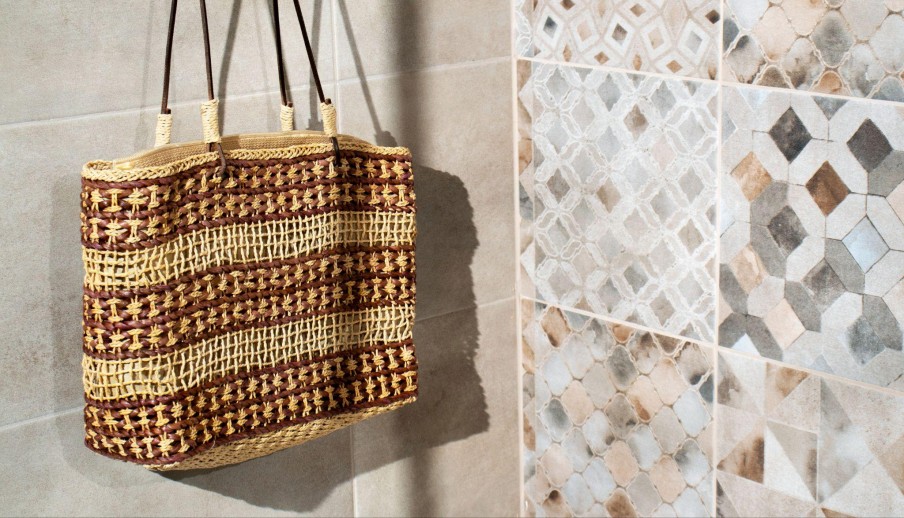
Colour discipline is non-negotiable. Modern interiors favour neutral and muted tones—greys, off-whites, warm beiges, charcoal, and soft metallics. Mosaic tiles that rely on high contrast, strong colour variation, or multiple hues often clash with this restraint.
Finishes for mosaic tiles such as matte porcelain, brushed metal, stone-look mosaics, or tone-on-tone glass are more compatible with modern aesthetics. The goal is cohesion. Once the mosaic stands out immediately from across the room, it is probably too dominant.
Scale and Tile Size Matter More Than Pattern
Smaller mosaics create more grout lines, increasing visual texture. However, in modern interiors, this texture must be controlled. Larger mosaic formats or elongated shapes tend to feel more contemporary than very small square tessellations.
That said, when tile shopping, view mosaic sheets from a distance, not just close up. Many homeowners choose mosaics based on detail, only to realise later that the overall surface reads as busy once installed. Modern spaces benefit from mosaics that read as a texture block rather than a detailed pattern.
Match Finishes With Surrounding Materials
Finish consistency is often overlooked. Glossy mosaics placed next to matte large-format tiles create unnecessary contrast. Similarly, highly reflective glass mosaics can clash with subdued modern lighting schemes.
Align mosaic finishes with surrounding surfaces. Matte-on-matte or soft-sheen combinations integrate more naturally. Amidst the city-state’s humid climate, this also has the added benefit of reducing visible water marks and maintenance issues, which is a practical consideration during tile shopping.
Think Long-Term, Not Trend-Driven
Modern interiors age quickly when design decisions are trend-led. Bold mosaic patterns may look striking initially but often date faster than simpler applications. A restrained mosaic accent is easier to live with, easier to update, and less likely to conflict with future renovations.
Additionally, evaluate whether the design supports flexibility. Neutral, textural mosaics adapt better to evolving interior styles than statement-driven options.
Conclusion
Mosaic tiles can coexist with modern interior styles when applied with discipline. The success lies in restraint, clear zoning, controlled colour use, and finish compatibility. The focus, for homeowners engaged in tile shopping, should shift from decorative appeal to architectural integration. Once mosaic tiles are treated as supporting elements rather than centrepieces, they enhance modern interiors instead of clashing with them.
Contact Soon Bee Huat and let us help you compare mosaic tiles against full-size slabs, lighting conditions, and real installation contexts.